Swings & Roundabouts


Dedicated to my Dad, Arthur Davies (September 1936 - June 2024), whose generosity, trust and foresight allowed us to acquire the field with all its possibilities and endless beauty
It is getting on for 3 years since my last blog post and how time flies. I started this blog really as a visual and written record for myself of the field and how it changes over time. I am learning that nature moves
sometimes in very surprising ways when given some leash and change can happen fast.
Having done most of the major 'capital works' in the first two or three years, it has been more or less a case since of seeing "what happens next," alongside doing some light management of the woodland, wetland and of course the meadow, during the year.
I can safely say we remain on a steep learning curve!

Peak Rattle
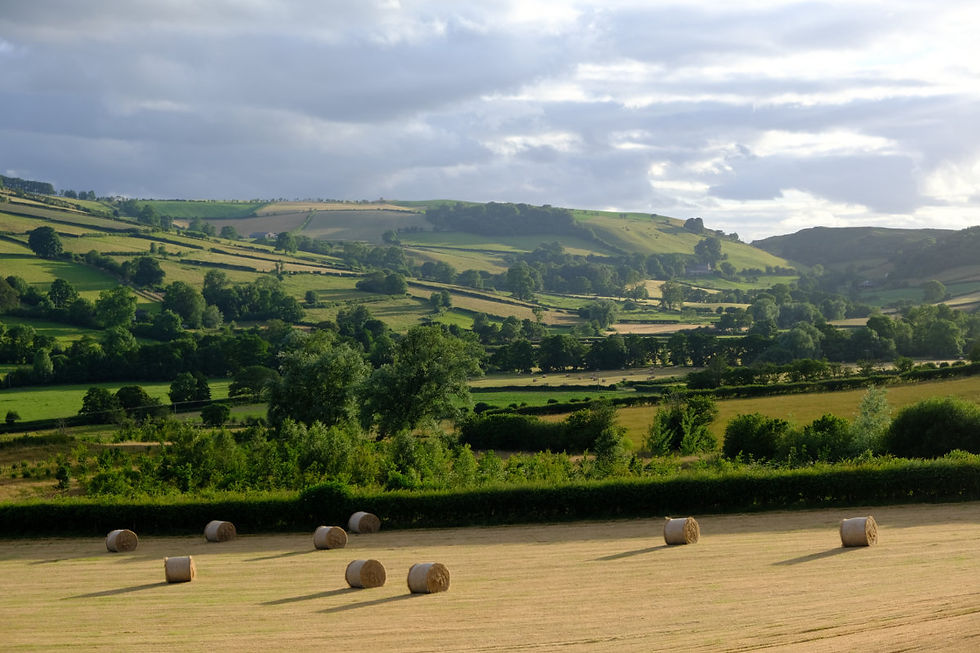
Yellow Rattle gained a major footing in the meadow two summers ago and I would say we hit Peak Rattle in the summer of 2025 (five/six years after sowing is apparently about right for Rattle to gain a stronghold; it should then start to fall away and reach more of a balance). Along with the very dry spring and summer last year we had the poorest hay harvest to date in 2025 at a mere 6 round bales: one bale an acre!

Summer 2026 is proving exceptionally hot and dry in Shropshire and we are now officially in drought. However, rain in late May (the only rain that month) seemed to prove that old adage that Rain in May is Hay in the Bay (or similar). And this year we had 29 bales, all now safely carted off to the farmer's barn for feeding their cattle later this year. We are very lucky to have farmer neighbours who are happy to mow the meadow for us every summer and take the hay since we have no livestock of our own.
In the lower meadow, following on from a green hay exchange 6 years ago, Eyebright, another semi parasitic annual meadow plant is now coming in quite strongly and provided a beautiful white under carpet through June. I have collected some seed to sow elsewhere. A visiting botanist told us that Eyebright is notoriously difficult to identify for sub species, but we possibly have Euphrasia Arctica. I was also told that we have 3 subspecies of Rattle, which was a very interesting suggestion since I happen to know we acquired our original Rattle seed from 3 different sources!
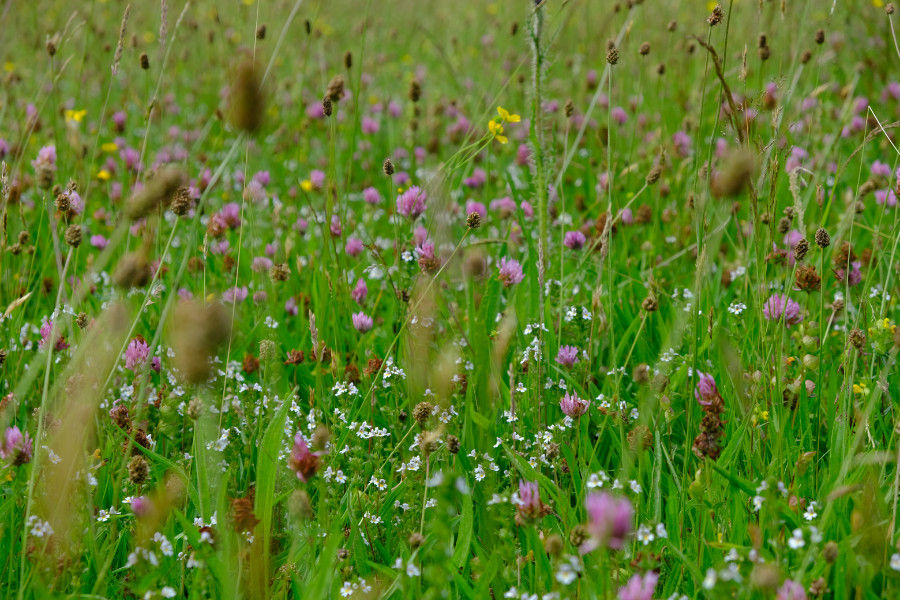
Other than adding Rattle in 2020, we've not really added anything further to the meadow so far other than some locally-gathered seed.
The sward has definitely changed with an increase in texture, colour and complexity with more flowering plants amongst the grasses including Cats Ear, some Pignut, Harebells, Birds foot trefoil, Yarrow although we have some way to go yet to get a species rich meadow per se which could take many years.
I have so far refrained from planting any plugs out. However, I have been given some native Devils Bit Scabious and Purple Loosestrife plugs (for the wetland) which we will plant out at some point to give some further late season flowers there in future years.
If anyone reading this blog would like Rattle seed for their meadow, drop me a line since we have harvested a small amount. It will need sowing by end of November this year.
Tumps come up trumps!

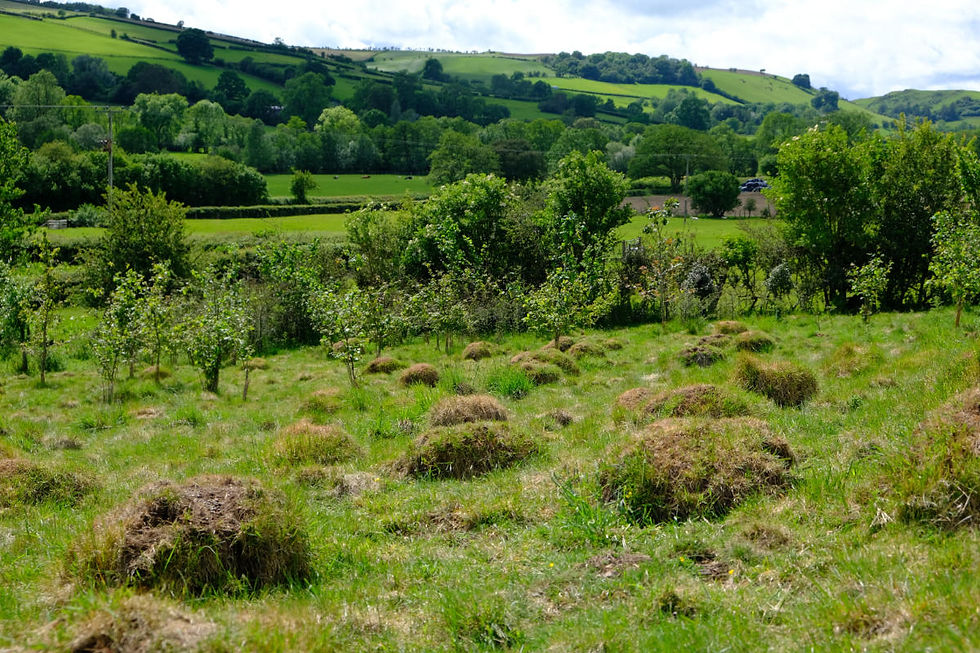
By mid July last year (2025), the anthills on the tumps were completely burned off and the grasses and flowering plants reduced to dried hay. The ground literally crunched under foot. I was really upset about this and didn't photograph it! However, to my surprise and delight the show of herbs and flowers on the tumps this spring (2026) was the best I have seen it, and I wonder if the grass (which is always a competitor to the finer plants) was set back by the drought last year leaving space for other seed to fall and germinate?


I sat on the tumps one late spring evening this year mesmerised by the swaying textures and multiple layers of soft colour - the rusty Sheep Sorrel and jewel-like Common Sorrel backlit by the sun, the new shoots of Ladys Bedstraw and Yarrow, yellow and orange eruptions of Birds Foot Trefoil, the tiny fine sedges and delicate grasses all making harmonies together as only native plants can. For me the real beauty is in the detail and intricacy and in the subtleties of shape, colour and form.
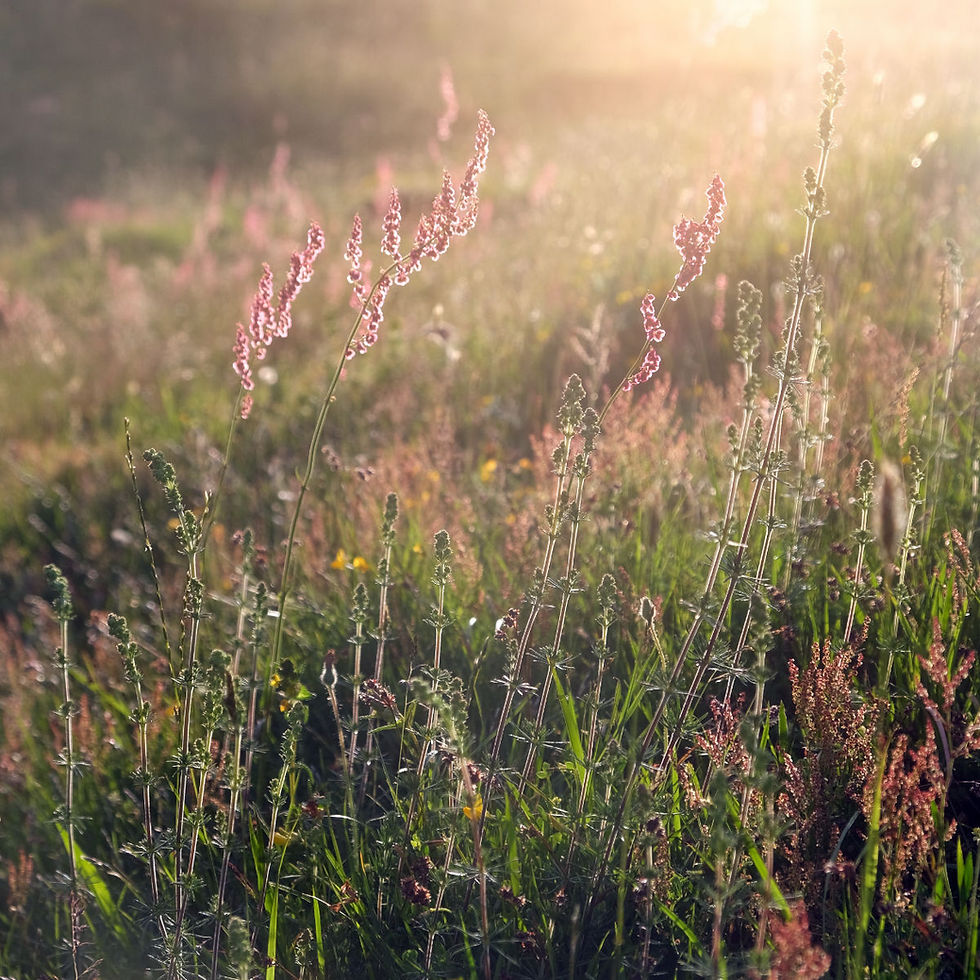
Birds Foot (Ornithopus perpusillus) not only bubbled up in a large mound in its usual position, but had seeded around for the first time. The flowers are absolutely tiny but exquisite. This plant is an axiophyte for Shropshire which means an indicator of good habitat.

By early August (at the time of writing) everything has turned blonde and dried out again after successive heatwaves and severe lack of rain. It looks tired. We just have to hope everything comes back with similar aplomb next Spring.
The far field
The far field where we planted trees along the Western edge had not been grazed or mown since 2019 apart from some areas being scythed and raked off for the last 3 years to help the wild flowers.
This spring we were offered the services of 2 rescue ponies to eat off the long grasses there. They stayed a month into May (a little late really). Their grazing revealed the size of the anthills that have bubbled up here since. I think we can safely say the height of an anthill is not an indication of its antiquity since these are some of the biggest we now have and they have just appeared in the last 4 years or so!
Meadow management summary
2024 Sheep on late in Autumn 2023 and tumps not as well grazed as usual
Wet spring - no sheep on in March/April. Summer cool and moist.
Haymaking in July: 40 bales Tumps and far side scythed & raked in September Sheep on Oct to Dec
2025
Hot and dry May, June and July (no rain in May)
Haymaking in August: 6 bales only!
Tumps and far side scythed & raked in September
Sheep on Oct to Dec (30-40)
2026 Wet winter; cool spring (until well into May)
Sheep on for 3 weeks in late March (30-40)
Then very hot and very dry May, June and July (with some rain end of May)
Haymaking 23/7: 29 bales
Wetland
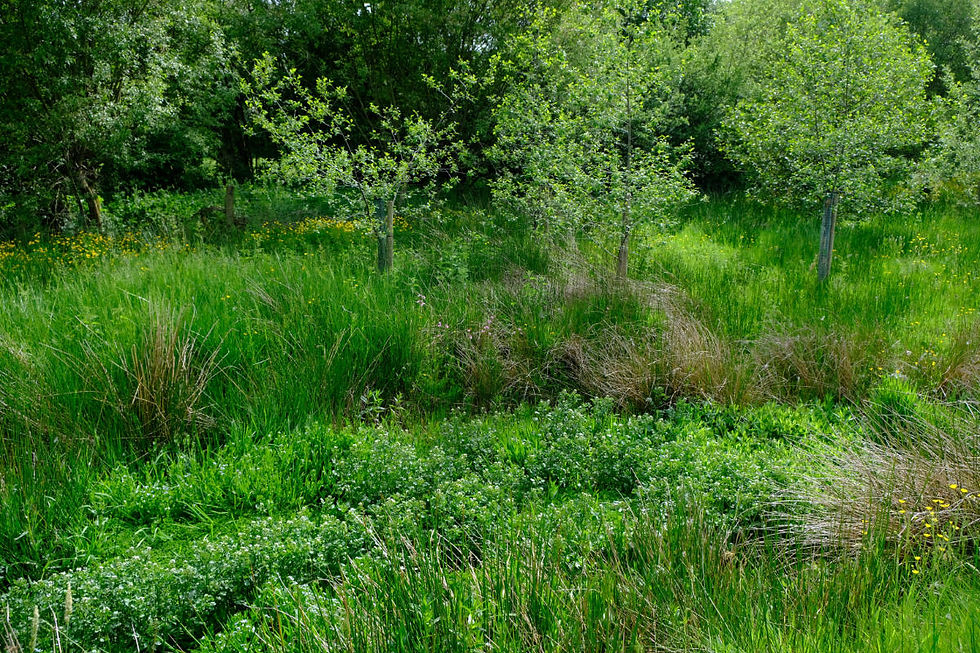
Whilst the meadow and tumps change slowly and more subtly over time, the wetland grows and changes fast. The Alders and Willow have shot up and are starting to elbow each other around, and the lovely sinuous view we had of the field barn from the far gate through the trees and down the path is already no longer visible in summertime. Self-set Alders and Willows grow along the watercourse which is choc-full of flowering vegetation of various kinds including Willowherbs, Water Forget-me-not and Watercress, each vying for position. Greater Birds-foot trefoil threads through the Soft rush creating tumbling carpets of mustard yellow (still out now) - a favourite of bumble bees.

We lost one or two of the Alders this Spring (not sure why) and Simon has cut them down to ground level to see if they will resprout next year. We have planted some Black Poplar (a rare tree now) from local stock and Simon made some lovely slate name tags for them. All trees here have to be guarded from rabbits for the first few years or they are eaten off.
We've carried out some tree management and coppiced or pollarded some of the 80 trees down to start to create a more varied structure. These trees should respond well to this. The Alder Buckthorn are producing quite a lot of berries this year which the birds are interested in.
Representatives from the Woodland Trust and Shropshire Hills National Landscape visited in April this year. They funded the woodland planting 6 years ago and returned to see how it was faring. Luckily they seemed pleased with progress and after a walk around the field, we enjoyed tea and cake in what was back then rare April sunshine.
Despite the drought conditions the watercourse continues to flow, albeit at a lower level which is reassuring. However the far pond has now reduced to 2 deep pools and is quite full now of reedmace which needs some management soon (came in on the feet of ducks or herons?). The water level has never been as low before. Perhaps it is also silting up a little (the pond is groundwater fed with no other source of water feeding in). I'm assured that ponds that dry up occasionally are not problematic and in fact ephemeral ponds build up their own particular (and potentially uncommon) invertebrate recruits.
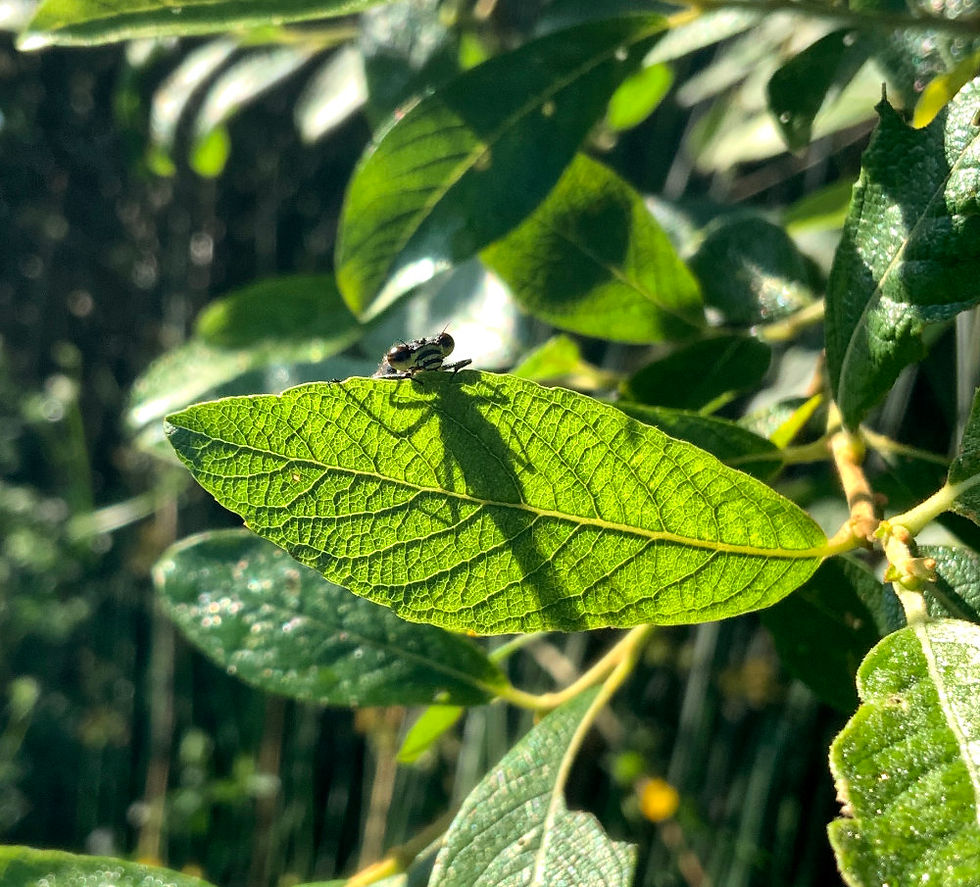
We have been doing some scything of Soft rush in the autumn months (the rush is very dominant) to get more light to the water, leaving plenty of cover for wildlife. Doing this provides a range of habitat textures, some open, some tall, some short, some closed, in the vegetation. It's a relatively species poor part of the field really although there are now some nice things now like Meadow Vetchling and Greater Trefoil, Marsh Bedstraw, Common Valerian and Tufted Vetch pushing in and lots and lots of Lesser Spearwort! Cuckoo Flower has not been as prolific in the last 3 years.

Duckweed and watercress are in a race to dominate the watercourse and both need a bit of management or they run totally rampant and blot out light from the water below. We take out some areas of watercress with a fork from time to time and tiny water shrimp slide out of the roots as we do so, back into the water. They seem to do everything sideways.

Walks and workshops
We have held several events and walks in the field in the last two years: field walks, art workshops (cyanotype, drawing and monoprinting) and a hedgerow surveying workshop for CPRE Shropshire. The newly repaired barn has come up trumps each time for shelter from hot sun or fierce rain! We really enjoy sharing the field with others.

Surveys and Species
Joy of Wildlife came for a third invertebrate survey in April 2025 and their list of found species is here.
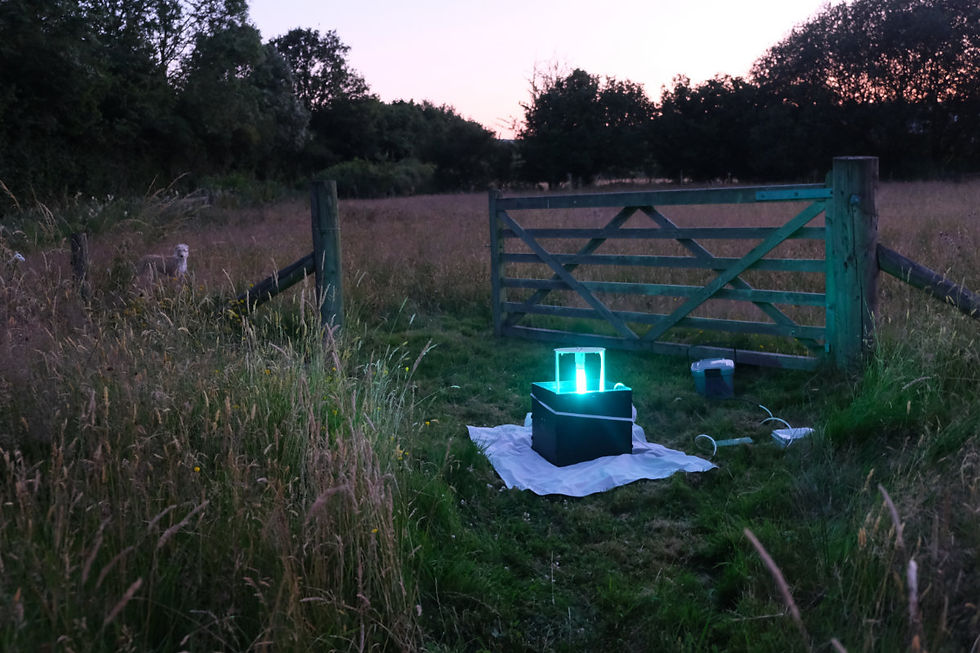
We had a fascinating early morning with Tess and Jill from Bishops Castle who set up moth traps out in the field in early July this year. We put one in the wetland and one in the new woodland and a third in our garden. We duly reconvened at 4am (I'm a night owl not a lark), and we spent a couple of hours uncovering the fascinating medley of moths that had been attracted to the light. Although we thought the wetland area would be ideal for moths as it is right next to the meadow (still with long grass) and the pond/watercourse, the count there was a bit low. We think that was down to the temperature having gone down to 6 degrees there overnight - so rather cool for moths to be out and flying? Discuss! A list of the species we found is here.
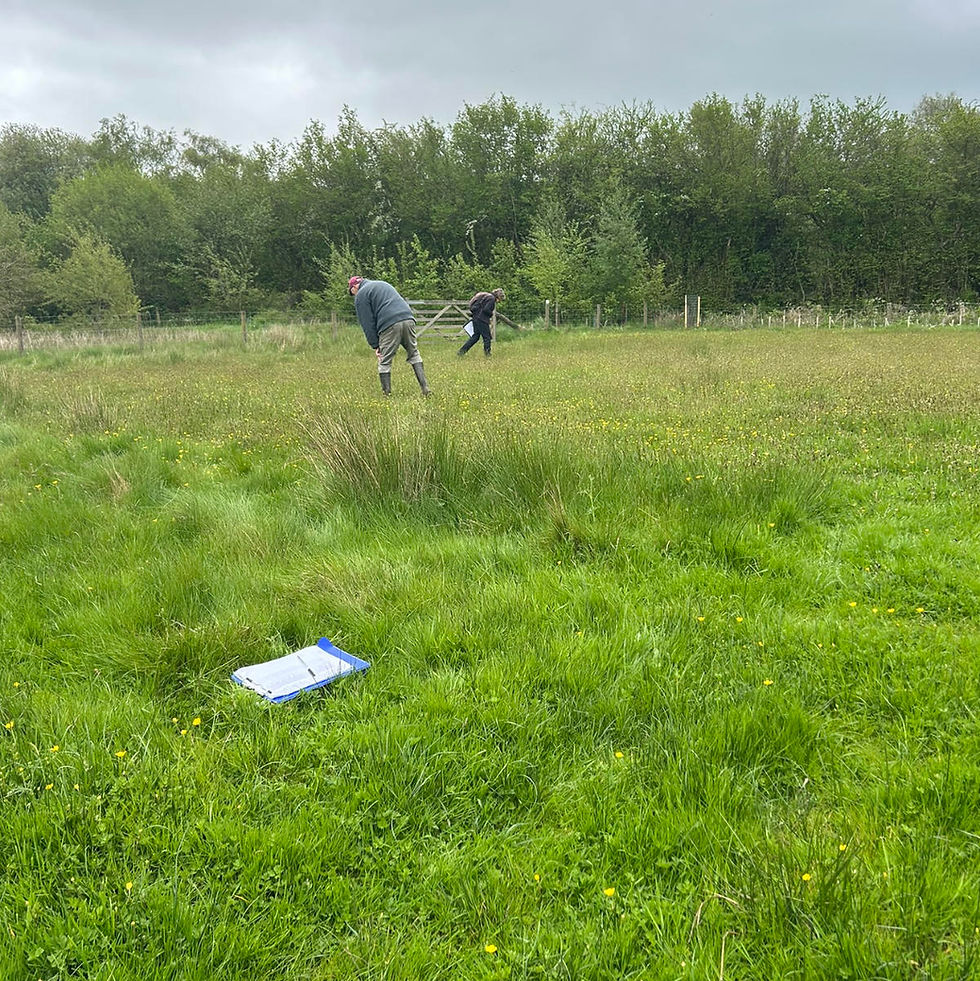
Caroline and Rob came to do a follow up meadow survey from the Marches Meadow Group (we are a member) in late May this year before the heatwaves came. In fact the cool spring meant a fair few things were not yet evident!
A book of the field
I realised a couple of years ago that my recording of the field and its story through this blog was less than secure, should the blog site ever 'go down' so I spent some time downloading all the blog entries and putting them into book form with a selection of photographs. I used Blurb to make the book. It's not really for sale since it costs a silly amount to publish (though Blurb do have good sales from time to time), but I have a couple of copies here now which I take to events and people seem to like looking at them. You can see it electronically here. This is an ongoing story, so at some point, there will be a sequel.

Photo Gallery
Below are some of the many photographs I've taken in the field over the last two and a half years through the seasons. They are captioned.
Lower tumps in the summer 2025. Rattle and ladys bedstraw Burnet moth on Ladys Bedstraw. A stunning moth to see on the wing. Skipper butterfly with a retinue of little black flies on Harebell White and red clover in the main meadow in early summer 2025 was the year of the gall. These are marble galls on Oak. More galls! Marble, Spangle & Artichoke (I think) on just one Oak branch The arc of the dog rose Golden Oat Grass, a fleeting grass that flowers so briefly Amongst the dog roses The wetland woodland in winter. Beginning to look like a wood now! Lichens on old Blackthorn in the hedge with sloes and other berries The top wood in May 2026 Lower tumps in flower, early summer 26 Backlit Common Sorrel Spindle berries looking like jewels Betony in flower 2026. Still hanging on with 4 plants now on the lower tumps. Spindle trees in autumn Tilly directing raking operations The view west from our field The lovely seedheads of Common Valerian Top wood by the pond in winter Barn and wetland area in winter snow Top wood in wintery garb Betony in flower on the tumps 2025 A Tree bumblebee on Bramble Birds foot Trefoil Flowering tumps The chaotic scramble that is the wetland Dear Tilly Tumps in late Spring 2026 Sheep in the lower meadow in snow Newly minted Painted Lady on Blackthorn May 2026 on the tumps The wood, winter 2025/6 Hay meadow baled August 2024 In drought, July 2026


Comments